
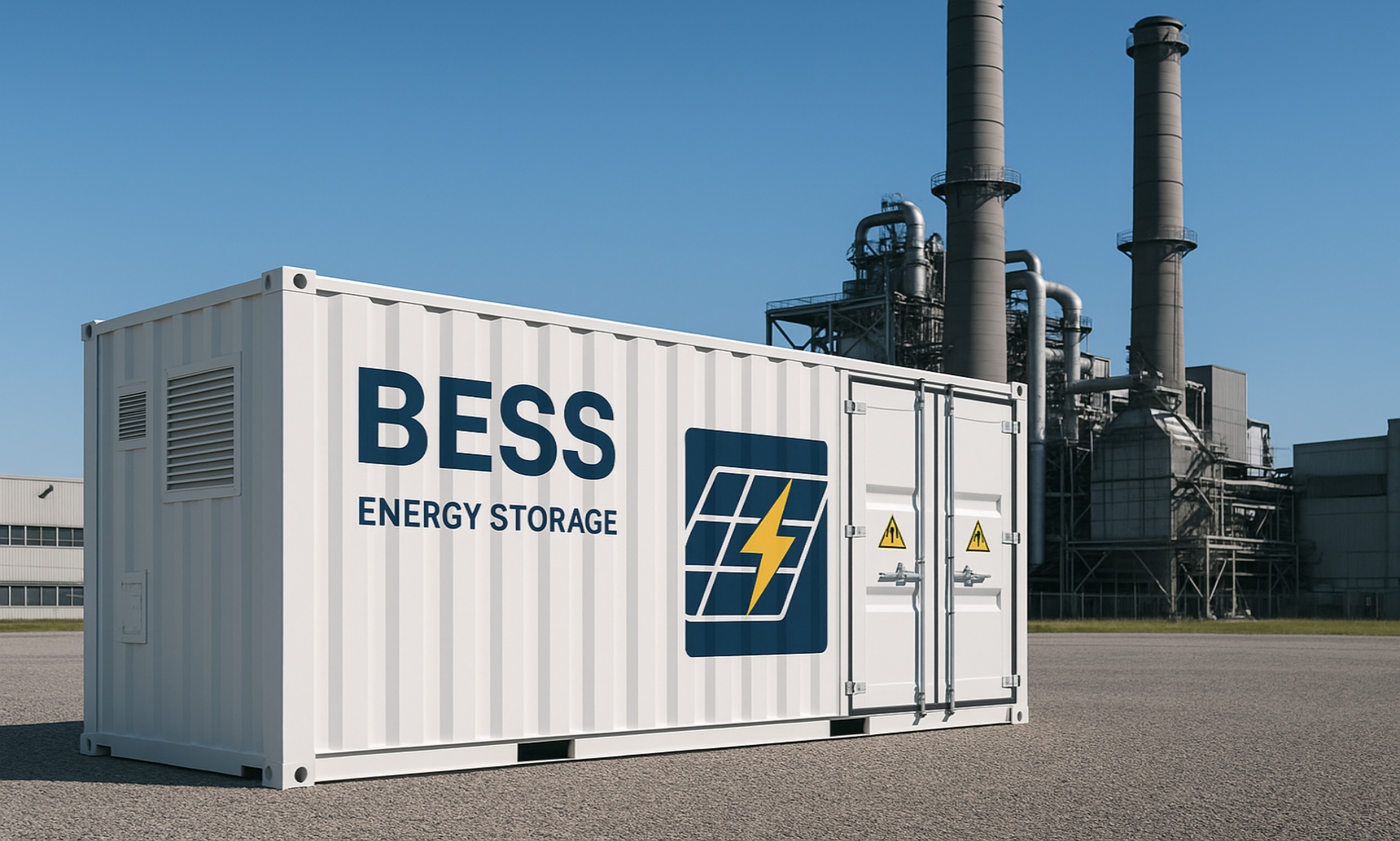
The energy transition has produced a long list of “next big things.” Most of them have delivered — solar and wind are now cost-competitive in most markets. But there is one asset class that has quietly moved from niche to necessary, and institutional capital has only begun to notice: Battery Energy Storage Systems, or BESS.
This is not a speculative technology play. It is an infrastructure story — one with the risk profile, return characteristics, and policy tailwinds that long-duration capital has historically gravitated toward.
Why BESS Now
The core problem with renewable energy has always been timing. The sun doesn’t peak when demand does. Wind doesn’t blow on schedule. Grids built for dispatchable, fossil-fuelled generation are increasingly being asked to balance intermittent inputs at scale — and they’re struggling.
BESS solves the timing problem. It stores energy when supply exceeds demand and dispatches it when the grid needs it most. At small scale, this is useful. At grid scale, it becomes essential infrastructure.
The numbers reflect this shift. Global BESS capacity installations exceeded 45 GWh in 2023, roughly doubling the year prior. Forecasts suggest this figure could reach 400–500 GWh annually by 2030 as grid operators, utilities, and regulators accelerate the build-out. Markets in the US, UK, Australia, and across Europe are now explicitly designing capacity mechanisms and ancillary service markets that remunerate storage.
For institutional investors, pension funds, sovereign wealth funds, infrastructure funds, insurance-linked capital, this represents a durable, large-scale opportunity that fits within existing infrastructure mandates.
“BESS is no longer a technology bet — it is an infrastructure mandate. The policy signals, the demand stack, and the return profile all point in the same direction.”
The Revenue Architecture
Understanding BESS as an investment requires understanding how these assets make money. Unlike a toll road or a contracted solar farm, the revenue stack for storage is layered and sometimes complex. But complexity, managed well, is where institutional-grade returns are built.
Energy arbitrage is the simplest layer: buy cheap, sell dear. As renewable penetration increases, price volatility in day-ahead and real-time markets widens. BESS assets positioned in high-penetration grids can capture this spread systematically.
Ancillary services — frequency regulation, spinning reserve, voltage support — are where storage assets genuinely shine. These are grid services that historically required fast-ramping gas peakers. BESS responds in milliseconds, not minutes, making it the superior technical solution. In markets like Great Britain and Australia, ancillary service revenues have at times been the dominant revenue source for standalone storage projects.
Capacity payments round out the stack. As gas peakers retire and regulators tighten resource adequacy requirements, storage assets with multi-hour discharge duration are being compensated for their availability during peak demand periods.
The multi-revenue-stream model is both its strength and its complexity. Experienced operators with sophisticated dispatch algorithms can stack these revenues intelligently. For investors underwriting projects, understanding how these streams interact — and how they evolve as market design matures — is the central due diligence challenge.
The Risk Landscape: What Investors Should Interrogate
BESS investments carry a distinct set of risks that don’t map neatly onto either traditional infrastructure or renewable energy project finance frameworks.
Merchant exposure is real. Unlike a contracted wind farm with a 15-year power purchase agreement, many BESS projects operate in fully or partially merchant markets. Revenue is not locked in, it is earned through active market participation. For investors accustomed to contracted cash flows, this is a philosophical shift. The question is whether merchant risk is priced appropriately and whether operators have the capability to manage it.
Degradation is a technical risk unique to batteries. Lithium-ion cells lose capacity over time, and the rate of degradation depends on usage patterns, chemistry, and thermal management. Underwriting the long-run performance of a BESS asset requires robust battery management assumptions, technology warranties, and increasingly augmentation strategies that maintain nameplate capacity over the project’s economic life.
Technology obsolescence sits in the background of every battery investment conversation. The lithium-ion cost curve has been steep and largely favorable, but next-generation chemistries — sodium-ion, solid-state, iron-air — are advancing. Investors with 20-year horizons need to think carefully about where the technology sits in its cycle and what refinancing or asset replacement scenarios look like at year 10.
Policy and market design risk is perhaps underappreciated. BESS revenue streams are deeply dependent on regulatory frameworks that are still evolving. A change in ancillary service market structure, a revision to capacity auction rules, or a shift in interconnection policy can materially affect project economics. This is not unlike the risk that solar investors faced a decade ago — and the lesson from that period is that policy risk is manageable with diversification and regulatory engagement, not avoidable.
The Institutional Case
Despite these risks, the structural case for institutional exposure to BESS is compelling.
First, the asset class is scaling into genuine infrastructure scale. Projects are no longer 10–50 MW curiosities; gigawatt-scale procurement is now routine in the US and increasingly in Europe and Asia-Pacific. The deal sizes, transaction structures, and counterparty quality are now within institutional comfort zones.
Second, the correlation profile is attractive. BESS revenues, particularly those derived from ancillary services and capacity payments, have limited correlation with broader financial markets. In an environment where institutional investors are actively seeking diversification, this is not a minor consideration.
Third, the policy architecture is supportive in a way that few other asset classes can claim. The US Inflation Reduction Act extended and expanded the Investment Tax Credit to standalone storage — a landmark policy change. The EU’s regulatory framework is accelerating storage deployment as part of REPowerEU. In the UK, the Contracts for Difference mechanism is being extended to long-duration storage. Governments across major markets are now treating storage as critical infrastructure, which has historically been the moment institutional capital finds its footing in a new asset class.
Finally, the competitive dynamics of energy markets increasingly favour storage. As renewables become cheaper and more pervasive, the value of flexible, dispatchable capacity rises. BESS assets, in well-designed markets, are structurally positioned to benefit from the very success of the energy transition itself.
The Positioning Question
For institutional investors, the question is no longer whether BESS deserves a place in the infrastructure allocation — it does. The question is how to get the sizing, timing, and execution right.
The asset class is past the experimental phase. It is moving through the rapid-scaling phase, which historically is when the best risk-adjusted entry points exist — before the market is fully priced for perfection, but after enough deal flow exists to build diversified exposure.
The grid doesn’t wait. And as every major power market tightens its resource adequacy standards and accelerates its renewable build-out, the assets that keep the lights on will command increasing value. Battery storage is not a transition technology. It is the infrastructure the transition runs on.